How agentic AI is reshaping collaboration between humans and machines.
From support to collaboration
Artificial Intelligence (AI) and automation are rapidly changing the way we design, operate and scale industrial systems. In factories, logistics centers and production lines, intelligent robotics, predictive analytics and adaptive control enable a new level of efficiency and precision. But as these technologies become more powerful, the next challenge is not simply to build smarter machines, but to ensure that people and machines can work together seamlessly.
Traditionally, automation has focused on repetitive or physically demanding tasks. With advances in machine learning and cognitive computing, systems are now evolving from tools to collaborative partners – not just executing instructions, but supporting, guiding and even augmenting human decision-making. This development requires a new class of solutions: assistance systems that complement human capabilities instead of replacing them. Such systems simplify complex processes, reduce errors and adapt dynamically to the context, creating a more intuitive partnership between humans and technology. “The next level of industrial intelligence will emerge where humans and machines not only work together, but also think together – supported by agentic AI that understands context and plans actions independently,” says Warren Purcell, AI architect and researcher in the Distributed Al Systems field at Siemens Austria.
“The next level of industrial artificial intelligence will emerge where humans and machines not only work together, but also think together.“
Warren Purcell, AI architect and researcher in the field of Distributed Al Systems, Siemens Austria
Software as active assistance
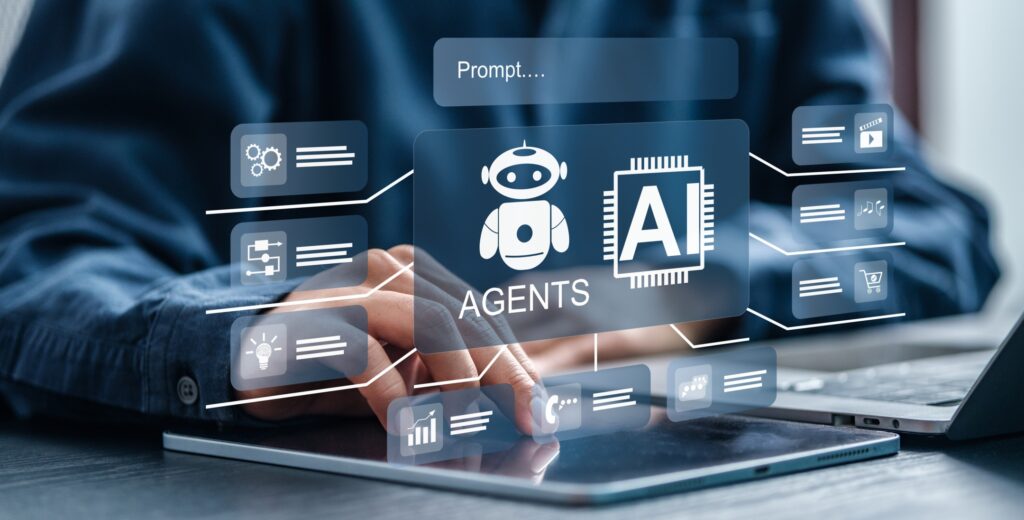
The emergence of Large Language Models (LLMs) and agent-based AI is driving this change even further. These technologies enable machines to interpret language, think through complex situations and plan actions autonomously. In combination with traditional automation functions, they enable software tools to evolve from passive decision-making aids to active “employees” who coordinate workflows, interact naturally with users and continuously adapt to changing conditions. For industry, this not only means more automation, but also more intelligent, flexible systems that can be easily scaled to different applications.
The emergence of Large Language Models (LLM) and agent-based AI is driving the partnership between humans and technology even further.
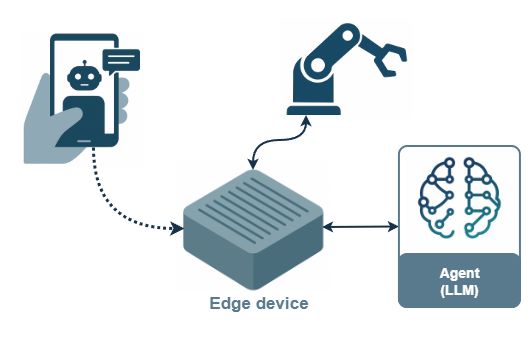
The FFG-funded project A2P (Assist to Produce), a cooperation between academic and industrial partners (TU/Technical University Vienna, Infineon Technologies Austria AG, 46NORD AUTOMATION GMBH, Siemens Aktiengesellschaft Österreich, Siemens Mobility Austria GmbH, University of Innsbruck), offers an initial insight into this future. The research goal: to rethink collaboration between humans and robots by integrating agent-based AI into industrial environments. While most collaborative robots today only provide physical assistance, A2P is investigating how cognitive intelligence can improve the partnership. By embedding LLMs in the robot’s control architecture, people can communicate with machines in natural language – configuring tasks, correcting errors or requesting explanations without having any programming knowledge. The robot becomes not just a tool, but a cognitive partner capable of suggesting next steps, adapting plans and solving problems together. “Agentic AI for cooperation with robots does not simply follow instructions. It enables collaboration at eye level, explains decisions and adapts dynamically to user input. “This approach will lead to more effective, intuitive and resilient collaboration between humans and robots,” explains Sebastian Schlund, university professor and head of the Industrial Engineering research area and the Human-Machine Interaction research group at the Institute of Management Sciences at TU Vienna.
“Agentic AI for cooperation with robots does not simply follow instructions. It enables cooperation on an equal footing.“
Sebastian Schlund, University professor, Institute of Management Sciences, Technical university Vienna
From command execution to problem solving
The project approach was validated in case studies ranging from quality inspections to cable assembly, in which interaction with robots took place via a chatbot interface. The results were clear: users found the system more intuitive and began to view the robot as an active partner in solving problems rather than a passive executor of commands. This change driven by Physical AI – from mere support to joint cognitive collaboration – is an important step towards more adaptable, transparent and human-centered production systems.
The same principles are now being extended to practical industrial applications such as SIMATIC Robot Pick AI, an image-controlled picking solution developed by Siemens. Thanks to zero-shot learning, this Siemens solution identifies and calculates robot grips for a wide range of objects – even those it has never encountered before. Since its introduction, SIMATIC Robot Pick AI has been designed to relieve warehouse workers by shifting their tasks from manual picking to monitoring robotic picking stations. In the future, an additional layer of intelligence – based on agent-based decision-making and natural language interfaces – could further improve this collaboration and transform robots from task-specific tools into adaptable partners in manufacturing. Operators will then be able to configure picking strategies on the fly, prioritize certain objects or exclude others – all through intuitive interaction. The result is a smarter, collaborative system that adapts to changing production requirements while leaving people in control. “Agentic AI has the potential to bring human-like thinking to production and meet individual customer requirements – and to do so during ongoing operations,” says Ines Ugalde, Senior Key Expert in the Future of Automation technology field in Berkeley, who is working on AI-based robotics with her colleagues from the Siemens Research and Innovation Ecosystem (RIE) Bay Area, just like the team in Vienna.
“Agentic AI has the potential to bring human-like thinking to machines in production and to meet individual customer requirements – and to do so on the fly.“
Ines Ugalde, Senior Key Expert at Siemens Foundational Technologies Bay Area, Berkeley
This convergence of automation, language intelligence and agent-based decision-making heralds a new era of industrial AI. As systems are increasingly able to understand relationships, think through tasks and communicate naturally, they will not only speed up production, but also enable people to work more creatively and strategically. The results of projects like A2P underline the transformative potential of human-machine collaboration and show how intelligent systems can work as true partners alongside humans – combining human insight with machine precision to create production environments that are safer, more flexible and more resilient. Based on these findings, solutions such as SIMATIC Robot Pick AI will translate these capabilities into practical applications and pave the way for next-generation assistance systems in real industrial environments.
 © A2P
© A2P