General, yet specific
The AI application "Federated Learning" offers benefits in terms of data security. A new, patented method helps to fully realize the future potential of smart manufacturing.
The AI application "Federated Learning" offers benefits in terms of data security. A new, patented method helps to fully realize the future potential of smart manufacturing.
Every time you type on your smartphone’s keyboard, data is collected to generate word predictions that continuously improve. Since these entries contain highly sensitive information such as passwords, private messages, and personal notes, central data storage poses a security risk. Federated Learning (FL) resolves this dilemma: The neural network is trained in a decentralized manner — each end device performs local training runs. Only the resulting model updates (weights) — not the raw data — are aggregated and transmitted to a central server. It combines the updates using secure aggregation methods to create a global model, which is then distributed to all devices. This results in a collectively improved model while ensuring data protection.
The transition of AI applications from research to industrial use is a challenge that often fails for many reasons — ranging from regulatory hurdles and strategic concerns to technical problems and cybersecurity risks. FL is a compelling option for addressing these challenges.
Regulatory hurdles
Challenges in this area include export controls (production data for dual-use goods), financial insider information from publicly traded companies (production throughput timestamps), and the GDPR. FL stores data locally and processes it at the source, ensuring compliance while keeping data accessible across national borders, organizations, and factories.
Strategic Considerations
Real-world use cases often require more data than a single organization can provide. Conflicting interests, concerns about unique selling propositions and intellectual property, as well as geopolitical tensions, often hinder data sharing — even in collaborations where there is no direct competition. FL reflects the strategic role of data: The data remains the property of the company; only specific insights (represented by the AI model) are shared. This allows companies to use industrial AI without compromising trade secrets.
Cost Concerns
Modern manufacturing facilities generate enormous amounts of data, especially in camera-based applications such as visual quality control, through intelligent robots, or the collection of high-frequency machine data such as motor currents. This data is generated in various sectors, such as the automotive, food, and logistics industries. These sheer volumes are driving up cloud transmission costs and the CO2‘s carbon footprint. FL significantly reduces both.
Cybersecurity Risks
Centralized data pools are attractive targets for attacks, and the damage caused can be exacerbated by data breaches. Operators of data pools must be mindful of cybersecurity risks as well as legal and reputational consequences. FL eliminates central data pools — an elegant way to mitigate risk.
In collaboration with the German software developer Katulu, Siemens used federated learning to improve the performance of automated optical inspection (AOI) at its plants in Amberg and Erlangen. The AOI there was inadequate, which led to errors being overlooked and false alarms for flawless circuit boards. The digitalization team at the two Siemens factories (EWA — Elektronikwerk Amberg and GWE — Gerätewerk Erlangen) had already been using a so-called XGBoost-based AI model for some time to analyze process data from the entire production line in order to reduce misclassifications.
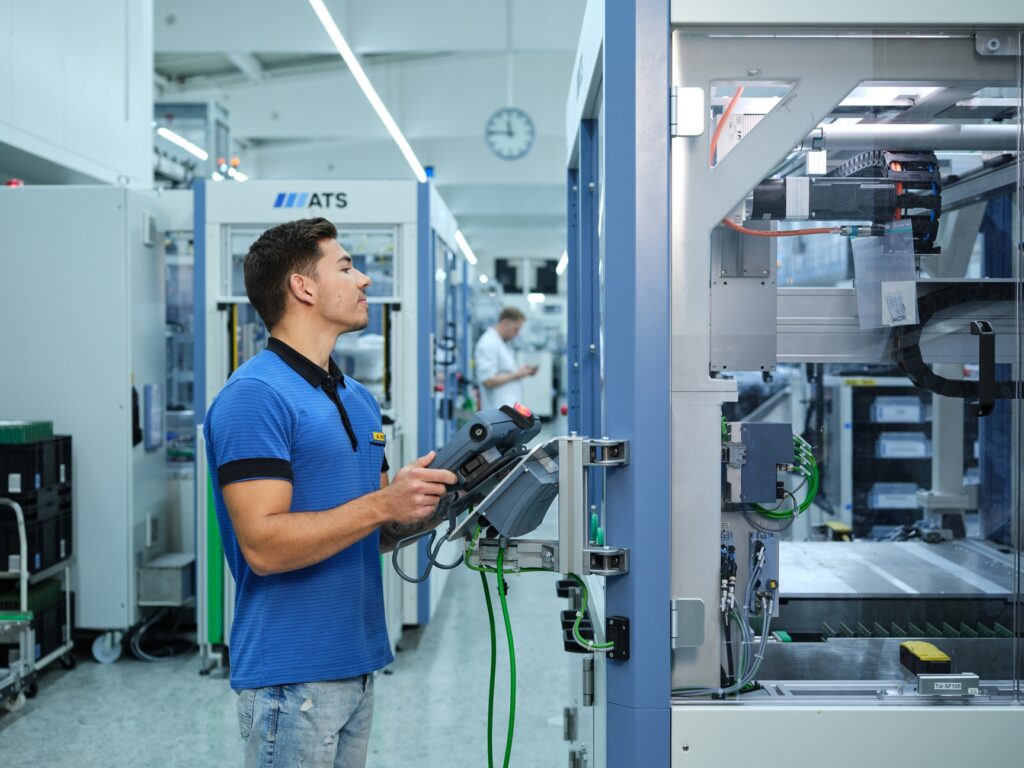 © Siemens
Automatic optical inspection has been improved at the Siemens electronics plant in Amberg through federated learning.
However, this model was limited to the trained printed circuit board (PCB) variants; it was not generalized and had to be adapted for each different PCB variant, production line, and location. The collaboration between Siemens and Katulu introduced federated learning to further improve AOI performance, reduce false alarms, and lay the groundwork for a rollout to other Siemens plants — including locations in China.
The FL implementation is based on the Siemens Industrial Edge (IE) platform, which provides various components for managing heterogeneous IT workloads in OT environments: a data bus for OT connectivity, an AI Software Development Kit for preparing AI pipelines, an AI Model Manager for version control, an AI Inference Server for model execution, and an AI Model Monitor for operational metrics. The solution architecture comprises four layers: the field level with data collection, the plant level with training capabilities provided by the FL agent, the private cloud with deployment functions, and the public cloud with the Katulu platform for model aggregation. This platform ensures data protection through differential privacy — the Katulu agent adds “noise” to the uploaded model weights to prevent reverse engineering, that is, the reconstruction of training data. This architecture has been successfully implemented at the Siemens plants in Erlangen and Amberg and can be easily scaled to additional locations.
 © Siemens
The Siemens Industrial Edge platform provides various components for managing heterogeneous IT workloads in OT environments.
Although the FL solution described is already quite advanced, it nevertheless quickly reaches its limits, especially in industrial practice. In traditional federated learning, a single global model is trained and distributed across all locations. The weaknesses of this “one-size-fits-all” approach are also evident in the Siemens example mentioned above: Although the plants in Erlangen and Amberg manufacture similar products, the production environments differ significantly — for example, due to different production line configurations, site-specific temperature profiles, and local environmental conditions. A purely global model inevitably requires compromises: What works optimally in Erlangen may be suboptimal in Amberg. In addition, there are future locations in China with entirely different operating conditions. A rigid, one-size-fits-all model either ignores local characteristics and squanders opportunities for quality, or it is so broadly defined that it fails to deliver excellent results anywhere.
A further development and improvement of the FL approach, designed to eliminate these shortcomings, is what is known as parameter-selective personalized federated learning. This was developed by researchers at Siemens Austria and resulted in a patent registered with the European Patent Office. This innovative method takes AI applications to the next level and overcomes the weaknesses of the “one-size-fits-all” model through intelligent segmentation: Common insights, such as fundamental error patterns, are shared as global parameters across all plants, while site-specific parameters remain local and adapt precisely to individual production conditions. Each plant benefits from the collective intelligence of all locations without losing its ability to optimize. The result is not a run-of-the-mill compromise, but a family of related, individually optimized models — each perfectly tailored to its specific application, yet all linked through shared learning.
The new development is being further tested and refined in the lab by experts from the Distributed AI Systems division at Siemens Austria. The next step is for the solution to pass practical testing at Siemens plants and ultimately become available as a Software-as-a-Service (SaaS) offering on the Siemens Xcelerator digitalization platform.