AI that fits into the smallest devices
How high-performance machine learning algorithms can be run on hardware with limited resources.
How high-performance machine learning algorithms can be run on hardware with limited resources.
While the world is captivated by ever-larger AI models that take up entire data centers, a research team centered around the Technical Universities of Vienna and Graz, in collaboration with industry partners, is pursuing a complementary approach: How can machine learning be brought to places where space is tight, energy is limited, and computing power is modest — directly into industrial devices or control systems? The Christian Doppler Laboratory for Embedded Machine Learning (EML) at the Vienna University of Technology is seeking the answer to this question in collaboration with Graz University of Technology, the mobility technology company AVL, Mission Embedded — a company that develops and manufactures highly reliable system solutions for safety-critical applications — and Siemens Austria. Together, they conduct research at the intersection of algorithms and hardware — with results that are not only scientifically significant but also increasingly relevant to industry.
Matthias Wess is a technology expert in electronic design at Siemens Austria and also a postdoctoral researcher at the aforementioned laboratory at the Vienna University of Technology. He exemplifies very well the symbiosis between the university and applied research in an industrial company — a core mission of the Christian Doppler Laboratories. “On the one hand, I’m conducting research as a postdoc at the Christian Doppler Laboratory, and on the other hand, I work full-time at Siemens, where I ensure that the results are actually put to use,” explains Wess. This close integration is no coincidence, but rather a matter of principle: The Christian Doppler Lab is based entirely at the university, but is co-funded by corporate partners and driven by specific use cases. Many of the students who work in the lab go on to join the industry directly — as working students, interns, or permanent employees. “That, too, is a positive synergy that’s emerging here,” says Wess.
But what is it actually about? At its core, it’s all about embedded systems — that is, computing units that are integrated into devices: from car controllers to industrial PCs in factories. The challenge: The powerful machine-learning models developed in research are often far too large and computationally intensive for such devices. Due to their memory and computational requirements, large language models (LLMs) generally cannot be used directly on embedded systems. “The main focus of our EML lab is trying to run algorithms that require powerful hardware on devices that aren’t really capable of handling them,” says Wess, describing the central research objective. This is not just a matter of miniaturization, but also of real-time capability, which is essential in industrial environments.
 © Christian Doppler Labor für EML/TU Wien
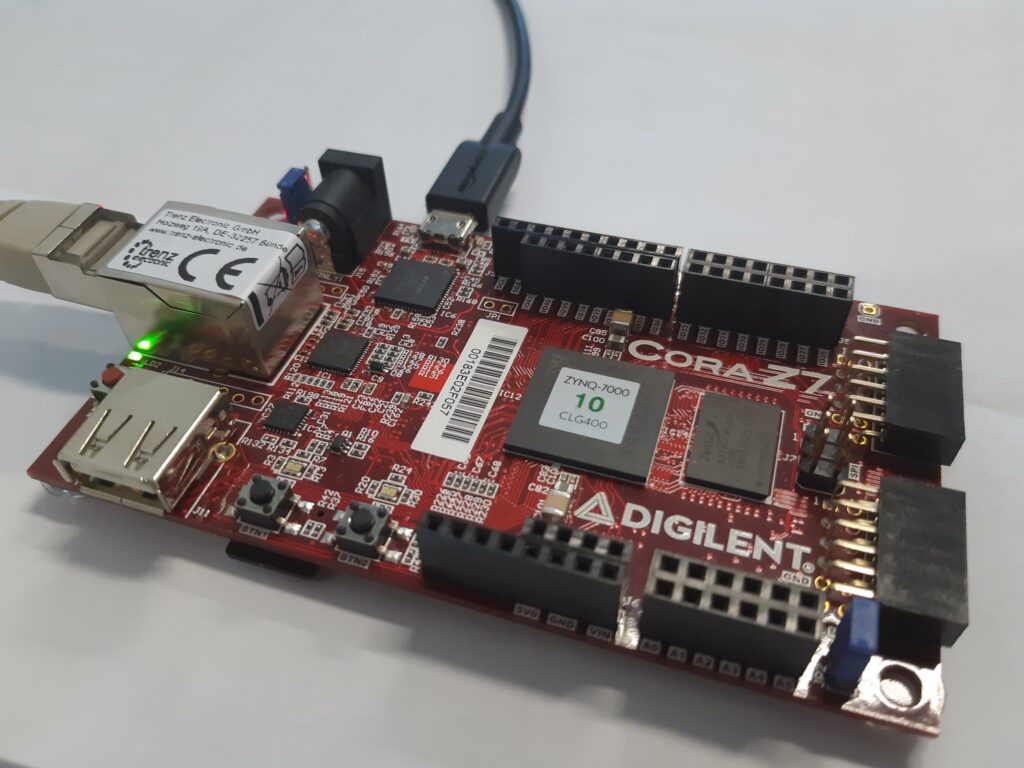
A typical hardware platform for research work.
Martin Matschnig, head of the Electronics Design and Integrated Circuits research group at Siemens Austria, emphasizes the strategic aspect: “We’re right at the device — the data isn’t transferred to be processed elsewhere. The goal is to be able to run the algorithms directly within a system using as little computing power and as little energy as possible.” This offers tangible benefits: Data does not have to be transferred to the cloud, which strengthens data protection and cybersecurity. At the same time, this saves energy and reduces the need for data centers — a key aspect of sustainability.
The laboratory’s structure reflects the breadth of the research questions. Two main areas form the backbone of the project: Graz University of Technology is contributing its expertise in computer vision and is working closely with AVL, particularly in the field of autonomous driving. The Vienna University of Technology, on the other hand, focuses on the embedded platform aspect. “That is the core of our joint research: computer vision and machine learning using embedded platforms,” explains Wess. Incidentally, both universities are also part of the Siemens Research and Innovation Ecosystem.
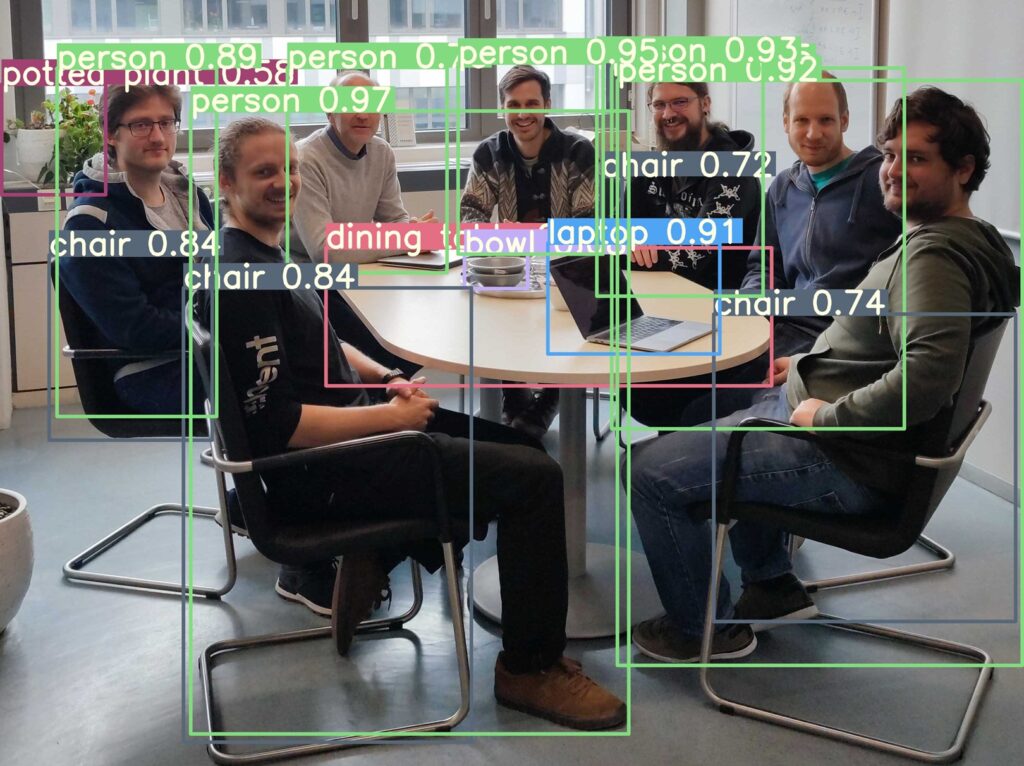 © Christian Doppler Labor für EML/TU Wien
The team at the Christian Doppler Laboratory for Embedded Machine Learning at TU Wien — captured by AI.
For Siemens, the focus is on a specific task that has long been neglected by the scientific community: the analysis of time-series data. “Many Siemens products contain microcontrollers or similar components,” says Wess. “We see great potential here for integrating machine learning directly into these devices.” Every temperature, current, or voltage sensor produces a time series, and industrial plants generate vast amounts of them. While LLMs aim to create a universal model for all types of data, this is not feasible on embedded systems. “Here, you have to consider the specific application and determine which algorithm will solve the problem efficiently,” Wess emphasizes.
One concrete outcome of this research is a framework that Wess developed as part of his doctoral dissertation. It serves as a performance estimation tool and helps identify the best and most efficient hardware solution for specific machine learning tasks. “Which algorithm should you choose for which hardware, and vice versa? There is a decision-making framework here that encompasses several dimensions,” explains Wess. His estimation tool predicts how long it will take to execute a specific algorithm on different hardware platforms. That way, you know which chip to install in which product. Matschnig adds: “We originally developed the tool for small Siemens industrial PCs, but it is also relevant for more powerful industrial controllers. In other words, wherever you have computing power available right in the field that can be used for machine learning algorithms.”
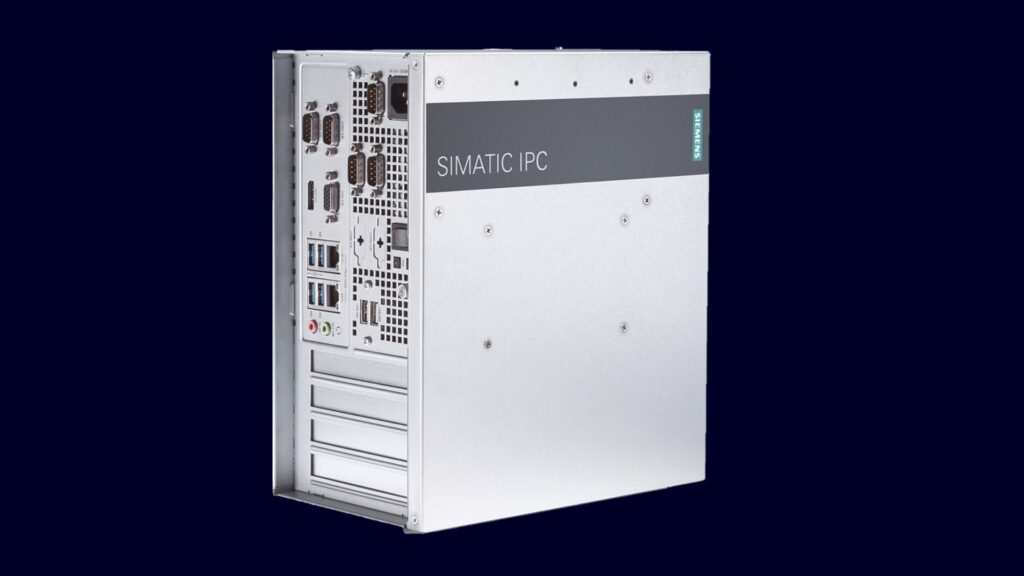 © Siemens
Industrial PCs and larger industrial control systems are computing resources in the field that can be used for machine learning.
It didn’t take long for international recognition to follow. “At the prestigious ICCAD conference, the EML Lab team won the TinyML Design Contest — beating out many groups from around the world,” reports Matschnig, who also highlights what makes research activities in Austria within the Siemens ecosystem so special: “Our USP is our focus on hardware, and specifically on integrated circuits. We have also specialized in the development of our own application-specific integrated circuits, known as ASICs, and in optimizing them so that we can tailor the algorithms to the specific problems at hand.”
There are already plans in place for the period after the lab closes in the fall of 2026: “We’re currently looking at individual devices — how do I deploy a machine-learning algorithm on a single device? The next phase of the Christian Doppler Laboratory will focus more on a systems approach,” says Matthias Wess. Specifically, this means: How can a machine learning problem be distributed across multiple devices with limited processing power? Ideally, what should be handled where to make the best use of the entire system? In this context, researchers are also exploring neuromorphic computing — novel computer architectures that are fundamentally better suited to handling machine learning workloads than conventional systems. At a time when AI is often equated with massive models and enormous energy consumption, this lab demonstrates — in both its current and upcoming research setups — that true innovation sometimes lies in thinking big — and developing “small” solutions.

Editor-in-chief hi!tech