“Virtual Sensor” Prevents Grinding Burn
Calculating the temperature from measurement data solves the grinding burn problem.
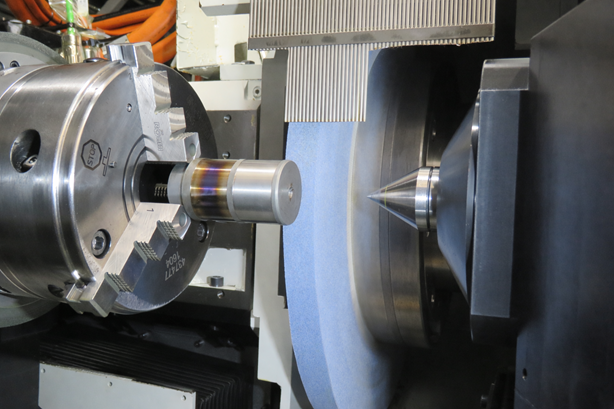
Calculating the temperature from measurement data solves the grinding burn problem.
We know this from our own experience: When you sand a surface with sandpaper, it gets warm. In an industrial grinding process, the goal is to operate at the highest possible grinding speed, which minimizes processing time and thus makes the process cost-effective and energy-efficient. However, the high grinding speed causes the surface of the workpiece to become not just warm, but hot. When the temperature is very high, the microstructure of the component in the edge zone changes — initially in a way that is invisible, but at even higher temperatures, this change becomes visible on the surface — a phenomenon known as “grinding burn.”
Typical advanced industrial materials, such as steel, are highly sensitive to temperature changes during machining. Overheating can cause the surface to become more brittle and alter its hardness. If a surface defect caused by grinding burn is not detected, the product manufactured using that part may have weaknesses. Such material defects are unacceptable, particularly in safety-critical components such as a vehicle’s steering axle or the crankshaft of an internal combustion engine. But even if the changes are visible — such as the blue-violet discoloration of the steel — it is too late by then: the workpiece is already damaged at the edges and is therefore scrap.
At first glance, the solution to this problem seems quite simple: You just need to measure the temperature at the point where the grinding wheel comes into contact with the workpiece. If this temperature approaches the critical value — above which grinding burn would occur — the grinding speed is reduced so that the temperature never enters the critical range. However, at this point, the temperature cannot be measured in a way that is economically viable for industrial purposes. You can’t attach a temperature sensor there — it would just get ground away. Measurement is also not possible with a thermal radiation sensor (infrared sensor), since in an industrial grinding process, a cloudy coolant circulates around the grinding area to cool the surface.
 © TU Graz
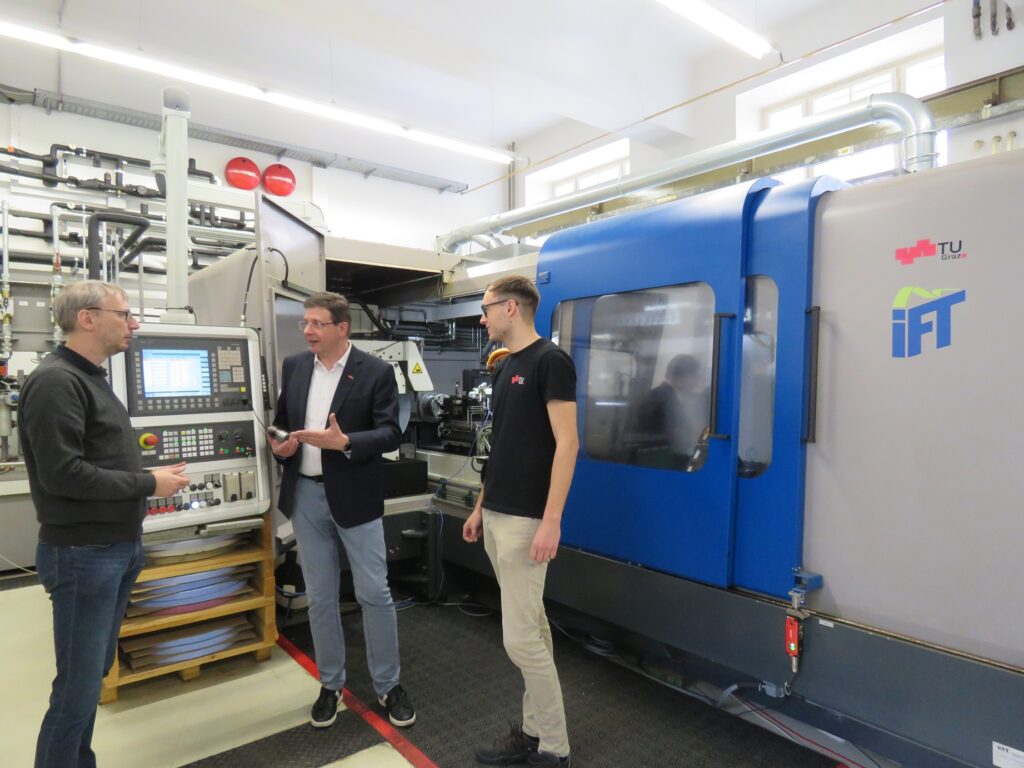
Prof. Franz Haas (center), director of the TU Graz institute, with project manager Dr. Jörg Edler (left) and master’s student Max Überbacher (right) at work on the GST grinding machine equipped with SINUMERIK control and Siemens Industrial Edge.
The Institute of Manufacturing Technology at Graz University of Technology, led by Professor Franz Haas, has collaborated with Siemens to investigate how to make what initially seemed impossible a reality: The solution is what is known as a “virtual sensor.” The idea: You measure what is measurable, and then use physical relationships to calculate what you actually want to measure. Specifically, in the case of preventing grinding fires: The electrical energy supplied to the grinding wheel’s drive motor is measured. In addition, the temperature of the outgoing coolant (which also contains the ground-off chips) is calculated, and from this, the energy removed by the coolant is also determined. The difference between the energy supplied and the energy removed is the amount of heat that, among other things, heats the workpiece. To calculate this heat generation accurately, you need the detailed material properties of the workpiece and the grinding wheel.
Max Überbacher developed the method used by this virtual temperature sensor to prevent grinding burn at the Institute of Manufacturing Technology as part of his master’s thesis. “The Siemens SINUMERIK controller for the grinding wheel’s drive motor knows exactly how much energy it needs at any given moment.” These values are then sent to the Siemens Industrial Edge computer every two milliseconds. “Using my formula, the temperature at the sliding contact can be calculated with sufficient accuracy,” explains Überbacher. His research advisor, Jörg Edler, adds: “The tests and material analyses have shown that the virtual sensor designed in this way works so well that grinding burn can be reliably prevented in mass production.”
 © TU Graz
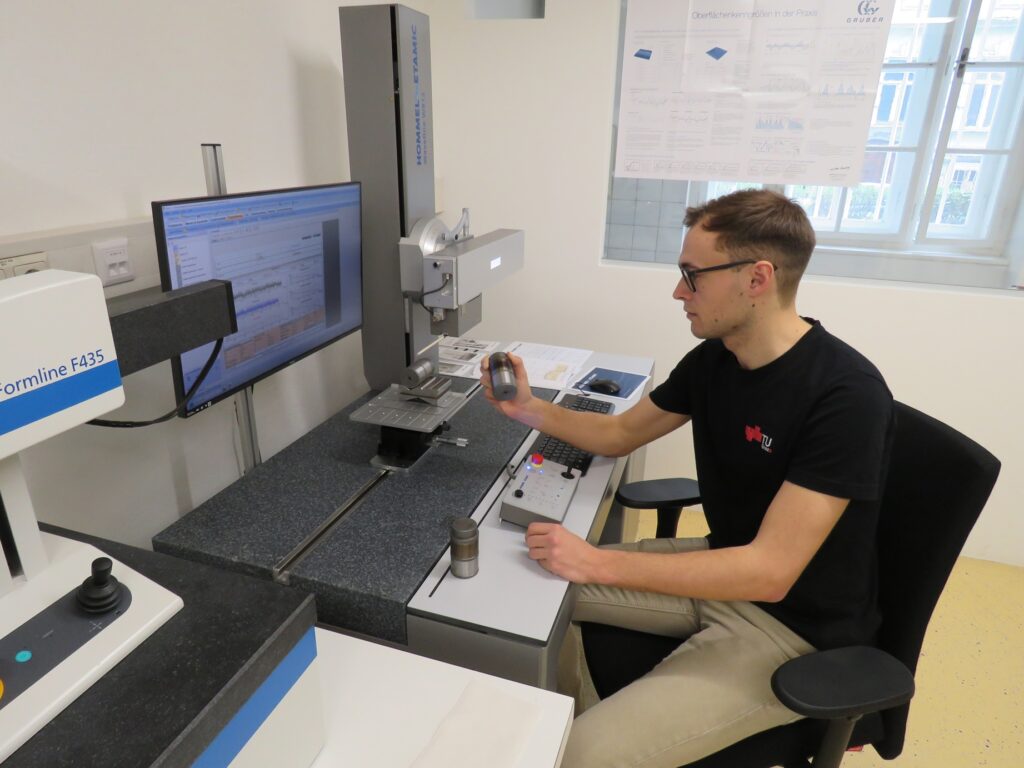
Master’s student Max Überbacher is checking the surface quality of the workpiece on the measuring machine.
Matthias Kneissl, Head of Mechanical Engineering at Siemens, explains the vision: “Today, material parameters for workpieces and grinding wheels still have to be determined manually from data sheets.” “In the future, this information will flow directly from the digital product passport into the digital twins of the product, machine, and production — enabling AI-driven actions that understand grinding processes in real time and prevent grinding burn from the outset.”

Michael Heiss ist Principal Consultant für Digital Enterprise bei der Siemens AG Österreich und Honorarprofessor für Innovations- und Technologiemanagement an der TU-Wien.