AI Revolution in Building Automation
A new AI assistant from Siemens supports the engineering of building control systems.

A new AI assistant from Siemens supports the engineering of building control systems.
Anyone planning and operating a modern building today cannot do without smart control technology. Ventilation systems, heating systems, sensors, and actuators must be configured, programmed, and coordinated — a process that previously required a great deal of manual labor and in-depth expertise. Until now, the software for a controller has been programmed manually in the engineering environment: creating devices one by one, manually configuring data points, and assembling the customer-specific system identification and functional logic step by step. To speed up these processes, Siemens is focusing its efforts here with its new AI portfolio for its Desigo smart building automation platform.
The first module of this customer offering is an AI assistant that is directly embedded in the ABT Site engineering software. With the click of a button, a dialog box opens that offers much more than just a simple search function. The assistant is familiar not only with the tool’s documentation, but also with the entire automation portfolio, including all of its features and configuration options. The AI Assistant helps with day-to-day work — from workflows and best practices to specific tips for working more efficiently. Above all, however, it helps develop customized solutions: Users can describe their specific problem, and the AI suggests appropriate solutions and guides them step by step through the implementation process. Direct questions about specific features are also answered precisely.
 © Siemens
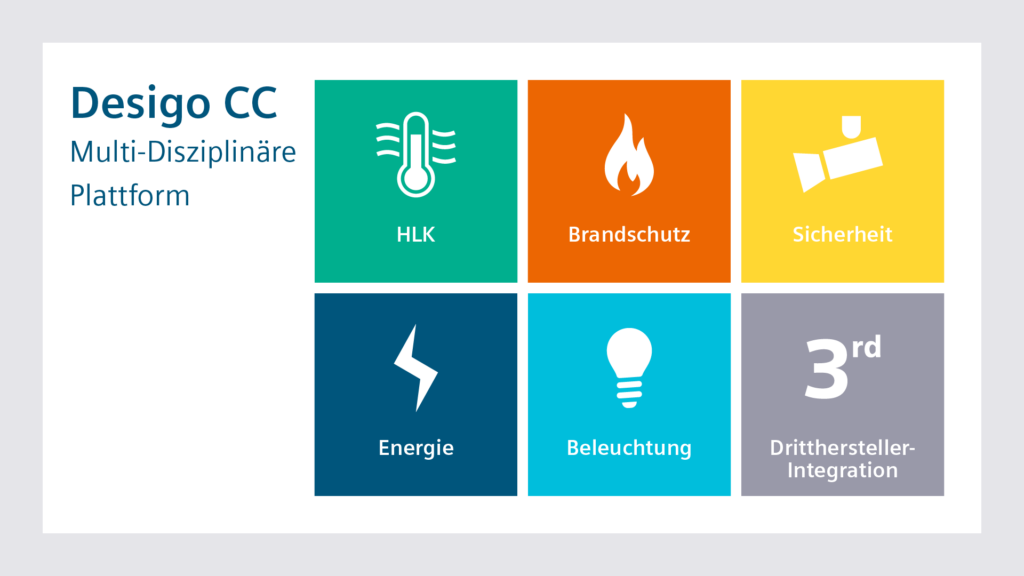
Siemens is expanding its intelligent building automation platform,
Desigo, with a new AI portfolio.
The AI assistant was unveiled to the public for the first time at Light+Building 2026 in Frankfurt — the world’s leading trade fair for lighting and building technology. At the Siemens booth, industry professionals were able to see the tool in action, and the feedback was consistently positive: Users particularly appreciate that the AI-generated information is presented in a targeted manner and is immediately usable.
The users of the new AI assistant are integrators and partners who purchase Siemens controllers and install them in buildings — ranging from office complexes to large hospitals. Siemens itself also uses the tool for large-scale projects. Technically, the assistant runs as a cloud application that connects to the local machine during active engineering so that it can work directly within the project. For users, the AI assistant means significant time savings and a lower barrier to entry into building automation. “With the AI Assistant, we’re not just adding another feature — we’re fundamentally changing how engineering works in building automation,” says Padmashil Pardikar, Product Management Manager responsible for Automation Engineering at Siemens Switzerland. Martin Lang, head of the building technology division at Siemens Austria, confirms that this change is already making itself felt in day-to-day operations: “For our partners — and for us as well — the AI assistant is a real game-changer.” “This allows our engineers to work much more productively and implement projects more seamlessly—from the initial configuration to the finished system.”
 © Getty Images
The AI assistant is embedded directly into the engineering software.
“From the initial idea to the release — in about eight months.” “That’s a remarkable pace — especially for a field with long innovation cycles,” emphasizes Lukas Krammer, Senior Research Scientist in the Sustainable Energy Solutions division at Siemens Austria. Behind this rapid development is a cross-functional team drawn from the areas of Smart Infrastructure/Building Systems, Technology/Research and Advanced Development, and Data & AI. Together, they work as an agile team with short innovation cycles. “As soon as a new feature we’ve developed is approved by everyone, it goes through the pipeline and is immediately visible in the product,” explains Ralf Bock-Oswald, AI & Machine Learning Engineer in the Data & AI division at Siemens Austria.
The next stage of development for the Desigo AI portfolio goes much further. With a future expansion, the assistant will evolve from an information provider to an active employee. Thanks to ABT Site’s existing interfaces, the AI will be able to create entire projects, configure devices, and generate data points — all based on user input. This is how a project description becomes a finished software configuration.
One of the reasons for the development team’s rapid success is its close relationship with customers. As early as after the first proof of concept, users — including some from Austria — who work with the tool on a daily basis were brought on board. The long-standing collaboration on the Aspern Smart City Research (ASCR) project also facilitates operational coordination between headquarters, the Austria region, and the operational experts. “We’ve already received feedback from key experts within the first few weeks,” says Ralf Bock-Oswald. These short feedback loops ensure that development does not lose sight of the market or actual needs. “This is very important: Don’t just develop the next assistant; instead, work in very short cycles to do exactly what benefits users,” said Lukas Krammer. The close relationship with customers that characterizes Siemens’ business in Austria thus contributes directly to the quality of a global Siemens product. The fact that the development was completed in less than a year is also due to the tools that Siemens provides to its teams. State-of-the-art development tools featuring the latest models significantly speed up code production — and are available to teams without long wait times.

Editor-in-chief hi!tech