Laboratory for Future Infrastructures
Aspern Smart City Research provides an urban test bed where strategic guidelines can be tested under real-world technical, economic, and organizational conditions.
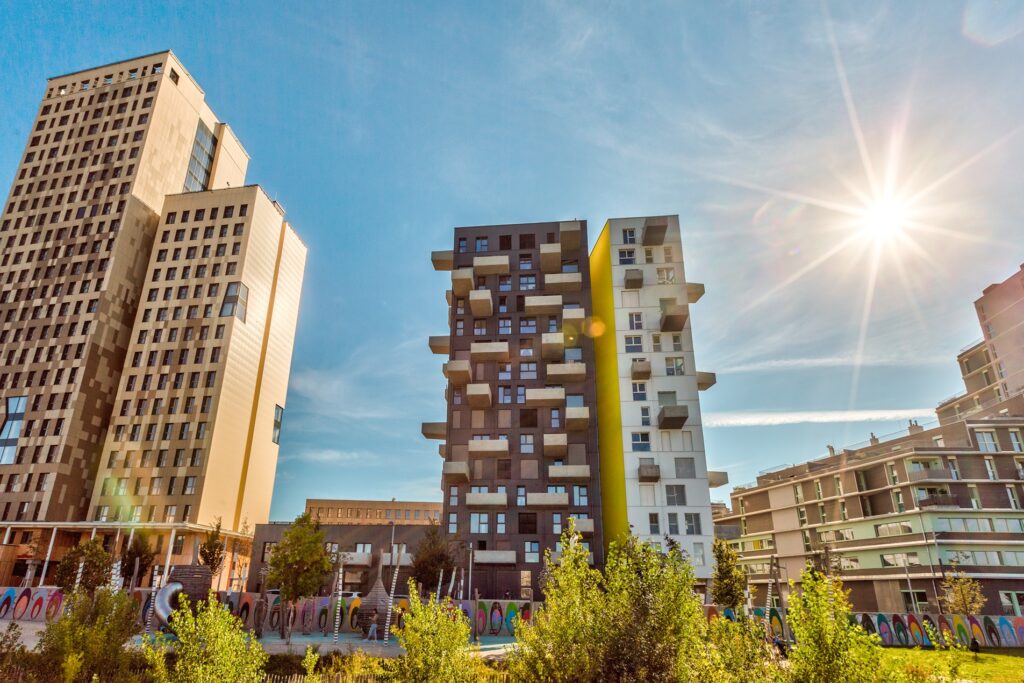
Aspern Smart City Research provides an urban test bed where strategic guidelines can be tested under real-world technical, economic, and organizational conditions.
Siemens’ Infrastructure Transition Monitor (ITM) offers up-to-date and in-depth insights into the global infrastructure transition: The study is based on a global survey of 1,400 executives — supplemented by interviews with experts — and examines how the development of energy infrastructure enabled by digital technologies is driving progress toward a climate-neutral future, as well as which developments, priorities, and challenges are shaping the decarbonization of buildings. It also provides insight into the industry’s progress toward sustainability. The findings have an impact on the research activities of Aspern Smart City Research (ASCR) — and vice versa: The research project, launched by Siemens, Wien Energie, Wiener Netze, and the City of Vienna, has been focusing on the future of urban energy since 2013. The interplay between the Infrastructure Transition Monitor and ASCR is particularly evident in three key areas: resilient operations management, cost-effective digitalization, and people-centered autonomy.
“Resilience is now considered a key capability of future infrastructures. “This refers not only to robustness in design, but also to the ability to respond dynamically to volatile market conditions — in particular, fluctuating energy prices, renewable energy feed-in, and increasing strain on distribution grids,” explains Lukas Krammer, Senior Research Scientist in the Sustainable Energy Solutions division at Siemens Austria. As market volatility increases, new functions are coming to the forefront, such as connectivity to energy markets, interfaces to the distribution grid, and the active use of flexibility from photovoltaic systems, batteries, and controllable loads.
 © Siemens
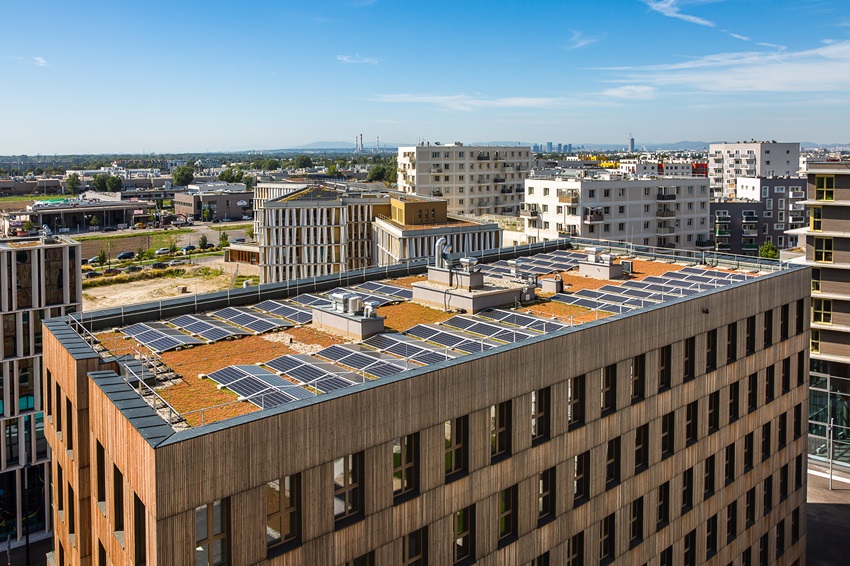
As market volatility increases, new features are coming to the forefront, such as the active use of flexibility from photovoltaic systems.
The Infrastructure Transition Monitor identifies digitalization as a key enabler, but at the same time makes it clear that fragmented, manual, or purely cost-driven approaches are no longer viable. “This is exactly where the smart office initiatives under ASCR come into play,” says Michal Majerech, Digital Services & Business Development in the Building Technologies division at Siemens Austria. The starting point is a simple but fundamental insight: The problem is not the space itself, but the lack of visibility regarding how it is used. Many buildings are still managed using static layouts, periodic occupancy studies, and isolated tools for booking, feedback, and communication. This often leads to underutilization, unnecessary costs, and missed opportunities, which also have an impact on energy management and building operations.
ASCR’s research therefore takes an incremental approach to digitization: Existing systems are retained, and new capabilities are added step by step in the most cost-effective manner possible. In addition, the focus is on a continuously updated status rather than on selective analysis. This solution enables the implementation of smart office features with minimal installation effort and very low upfront costs — a crucial prerequisite for scalability. This logic is carried forward in Building X Space & Workplace, thereby addressing precisely what the Infrastructure Transition Monitor calls for: digitalization as a means to achieve adaptability, efficiency, and user acceptance — and not as an end in itself.
 © Getty Images
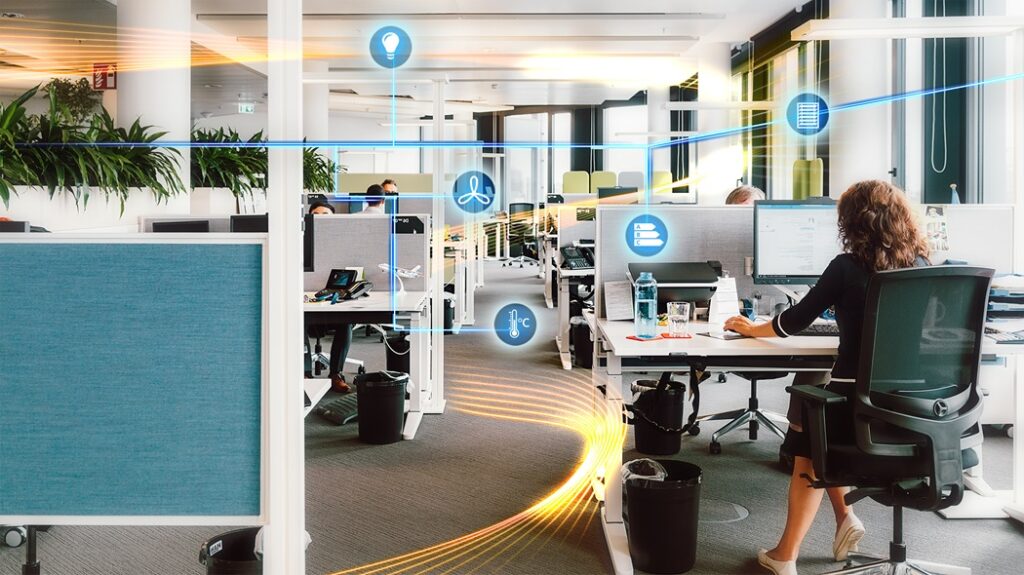
Smart office activities are part of Aspern Smart City Research’s incremental approach to digitalization.
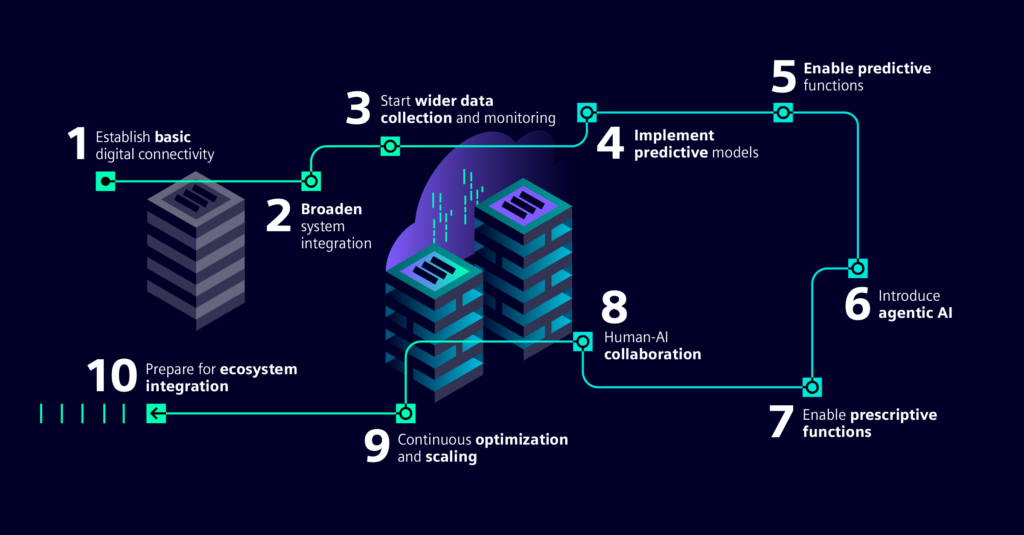
Autonomy is one of the most prominent topics in the Infrastructure Transition Monitor — and at the same time one of the most sensitive. ASCR research provides a realistic, step-by-step approach to autonomous building functions based on Siemens Building X — the open digital platform for sustainable buildings. “The next step in development is not only to make buildings transparent and digitally controllable, but also to allow them to operate increasingly autonomously within defined limits.” “That’s exactly how we move from smart buildings to more autonomous ones,” says ASCR Managing Director Matthias Gressel. However, it is not just the technology that is crucial here, but the operating model. “Autonomous systems are intended to handle routine tasks, while humans retain control over goals, priorities, and escalations,” says Gressel, describing the underlying vision. That is precisely where the added value lies: operational processes become more stable, response times are shorter, and reliance on manual intervention is reduced — without relinquishing responsibility. “The ASCR test bed provides the ideal environment for testing such approaches in a practical manner under real-world conditions together with our stakeholders,” Gressel emphasizes.
 © Siemens
ASCR’s research provides a realistic, step-by-step approach to autonomous
building functions based on Siemens Building X.
Of course, this also places demands on grid operators, as the power grid must allow for a high degree of flexibility. Just as with buildings, the trend on the internet is also moving toward AI. Matthias Gressel sees opportunities and strengths here, because AI can “suggest operating modes, highlight options, or generate analyses and derive recommendations from them.” “And it can autonomously optimize running systems within a defined framework.” Alfred Einfalt, Principal Key Expert for Distributed Energy Systems at Siemens, adds: “The key factor is not the technology, but the operating model.” “The vision is this: Autonomous systems will take over routine tasks — while humans retain control over goals, priorities, and escalations.”
ASCR is currently conducting research with Siemens and the Vienna Business Agency — the owner of its own technology center — to explore how autonomous buildings interact with other buildings within a neighborhood. “We want to implement a comprehensive energy system that is ideal from both an environmental and economic perspective for the three existing buildings and the two that are yet to be constructed,” says the ASCR managing director. Specifically, this requirement is addressed by b.eos (Building Energy Optimization Suite), which was developed and refined primarily in the context of Aspern with the goal of viewing buildings not in isolation, but as active participants in the energy system. The insights gained from this have already been clearly incorporated into the key messages of the Infrastructure Transition Monitor. Lukas Krammer: “This project is laying the empirical groundwork for how resilient concepts can actually be implemented.”
While in the past, a great deal of attention was focused on optimizing newly constructed buildings, research is now increasingly turning its attention to existing buildings. Not least, the ASCR partners — Vienna Business Agency and Wiener Stadtwerke, which own a large number of older buildings dating back to the Gründerzeit era — are interested in the idea of supplying these buildings with renewable energy sources instead of gas. “If possible, in addition to thermal retrofitting, the use of renewable energy sources in combination with smart technology is a major factor in achieving this goal,” says Matthias Gressel, but this isn’t fully feasible everywhere. The use of district heating would also be possible, but it would have to be completely decarbonized. This is currently being promoted in Vienna through measures such as high-performance deep geothermal systems. A research project on this topic is currently underway involving a commercial property owned by the Vienna Economic Agency. Through numerous simulated and practical experiments, this project aims to identify the optimal approach and, as a prototype, establish the knowledge base for many other buildings.