Between Hype and Hope
Quantum computing for highly complex industrial applications that push classical computing methods to their limits.

Quantum computing for highly complex industrial applications that push classical computing methods to their limits.
The industry is at a turning point. Not because a single technology is changing everything, but because the fundamental conditions of industrial thinking are shifting. Production systems, supply chains, energy infrastructures: What once functioned as a separate entity is now part of highly interconnected structures in which data, simulations, and decisions are interlinked in real time. The real and digital worlds are increasingly converging: systems are no longer merely operated, but are continuously analyzed, simulated, and optimized.
However, this interconnectedness brings to light a problem that had long remained in the background: complexity. In many industrial applications, the number of possible states increases so dramatically that traditional computational methods reach their structural limits. In computer science, this is referred to as combinatorial complexity — a phenomenon that increases not linearly but exponentially as the size of the system grows. For companies, this means that decisions are increasingly becoming computational challenges for traditional computing systems. And these computational problems require new approaches.
Artificial intelligence has become firmly established in industry in recent years. It analyzes data streams, identifies patterns, and optimizes processes throughout the entire value chain, from design and engineering through to ongoing operations. The effects are measurable: processes become more efficient, downtime decreases, and resources are allocated more effectively. However, as connectivity increases, it also becomes clear just how complex industrial systems have actually become — and that their limitations are determined not only by a lack of data, but also by the architecture of today’s computing systems.
Many industrial problems can be described precisely using mathematics. However, with each additional variable, the solution space does not grow incrementally, but rather in leaps and bounds. In research, these are referred to as NP-hard problems — tasks in which even the fastest classical computers get bogged down in astronomically long computation times. In research and industry, there is often talk of so-called “trillion-dollar problems”: highly complex challenges in materials development or energy optimization, the solutions to which promise economic potential on a scale that is almost impossible to fathom. Rather than more computing power, this situation calls for fundamentally different approaches.
Quantum computing is therefore becoming a greater focus of industrial research. It uses phenomena such as superposition and entanglement to tackle problems that push classical computers to their limits. The underlying quantum mechanics is one of the most precise theories in modern physics — and yet its interpretation remains a mystery to this day. It is precisely this tension between mathematical precision and an elusive physical reality that is also reflected in the development of practical quantum technologies.
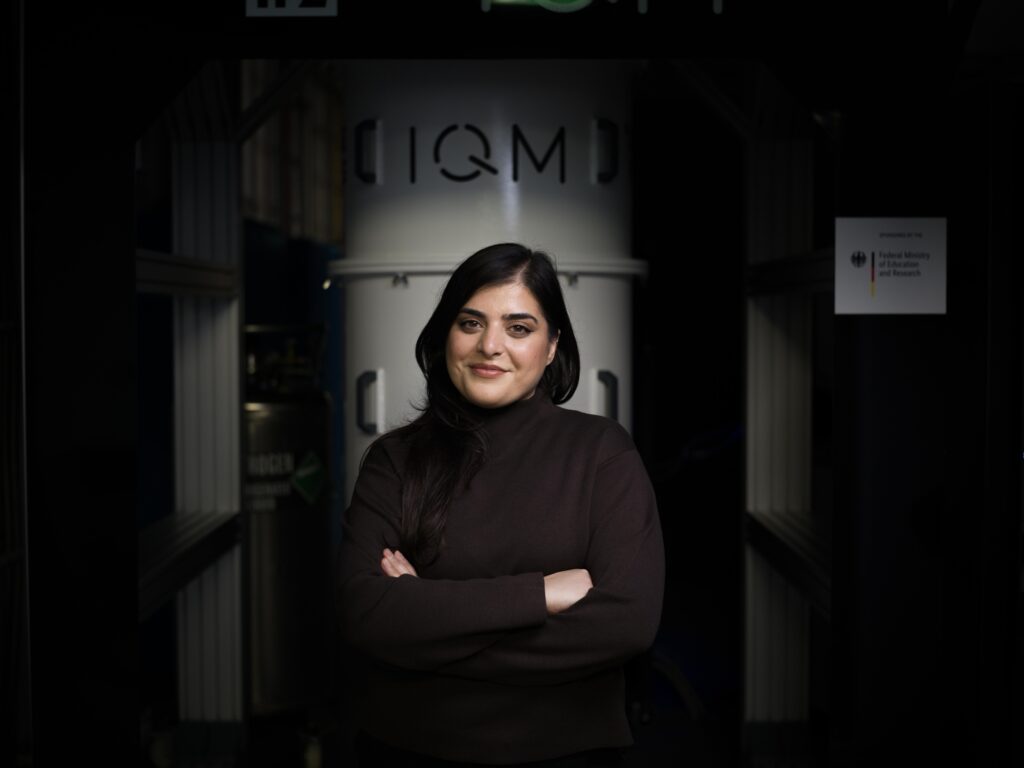
First, there are signs of a shift toward hybrid architectures: traditional high-performance computers, artificial intelligence, and quantum processors work together in a complementary manner — with each technology utilized where its strengths lie. “Increasing complexity forces us to compute smarter rather than just faster — and that starts with asking the right questions before writing the first algorithm,” says Hila Safi. She is a quantum expert at Siemens, and she works on digital twins for quantum computers. Her research focuses on how sensitive quantum systems could be used stably and reliably in real-world industrial environments in the future.
 © Siemens
Hila Safi, quantum expert at Siemens
Initial pilot projects demonstrate just how far along this development already is. Companies and research institutions are experimenting with quantum algorithms and testing potential areas of application. Initial prototypes are possible, but the technology is not yet stable or scalable enough for widespread use. Those who invest now are investing in positioning. The current state of development still calls for a sober assessment: Many quantum systems are in an early, error-prone stage and are not yet sufficiently scalable for widespread industrial use.
At the same time, companies, research institutions, and technology providers are already working on ways to integrate quantum algorithms into industrial processes in the future. Quantum computing is increasingly being viewed not as an isolated technology, but as part of a larger ecosystem of software, data, and AI. Quantum computing becomes particularly relevant in situations where systems are difficult to simulate or optimize. In the simulation, quantum computers could eventually model physical processes at the atomic level with greater precision. Optimization involves identifying robust solutions from an astronomically large number of possible states, such as in production planning or complex logistics systems. It’s not just the hardware that matters here. Only with the right software and open platforms can different technologies be effectively combined and integrated into industrial processes.
As technology advances, a new industrial ecosystem is emerging, comprising research, software, and specialized hardware platforms. However, the focus does not shift to computing power itself. Not every calculation needs to be completed in full. Especially when it comes to complex optimization problems, the intelligent reduction of the search space is becoming increasingly more important than raw computing power. At the same time, energy efficiency and scalability are becoming increasingly important, because every calculation comes at a physical cost.
The question that remains is not so much whether quantum technologies will play a role, but rather when and to what extent. Many applications are still in the experimental stage. At the same time, it becomes clear in which direction industrial systems are evolving: toward highly interconnected structures whose control systems are becoming increasingly complex. The key change here lies not only in new machines, but in understanding how industry will do business in the future.